
 Asanas & Anatomy
Chaturanga Dandasana: The Foundation of Arm Balances
Chaturanga Dandasana: The Foundation of Arm Balances
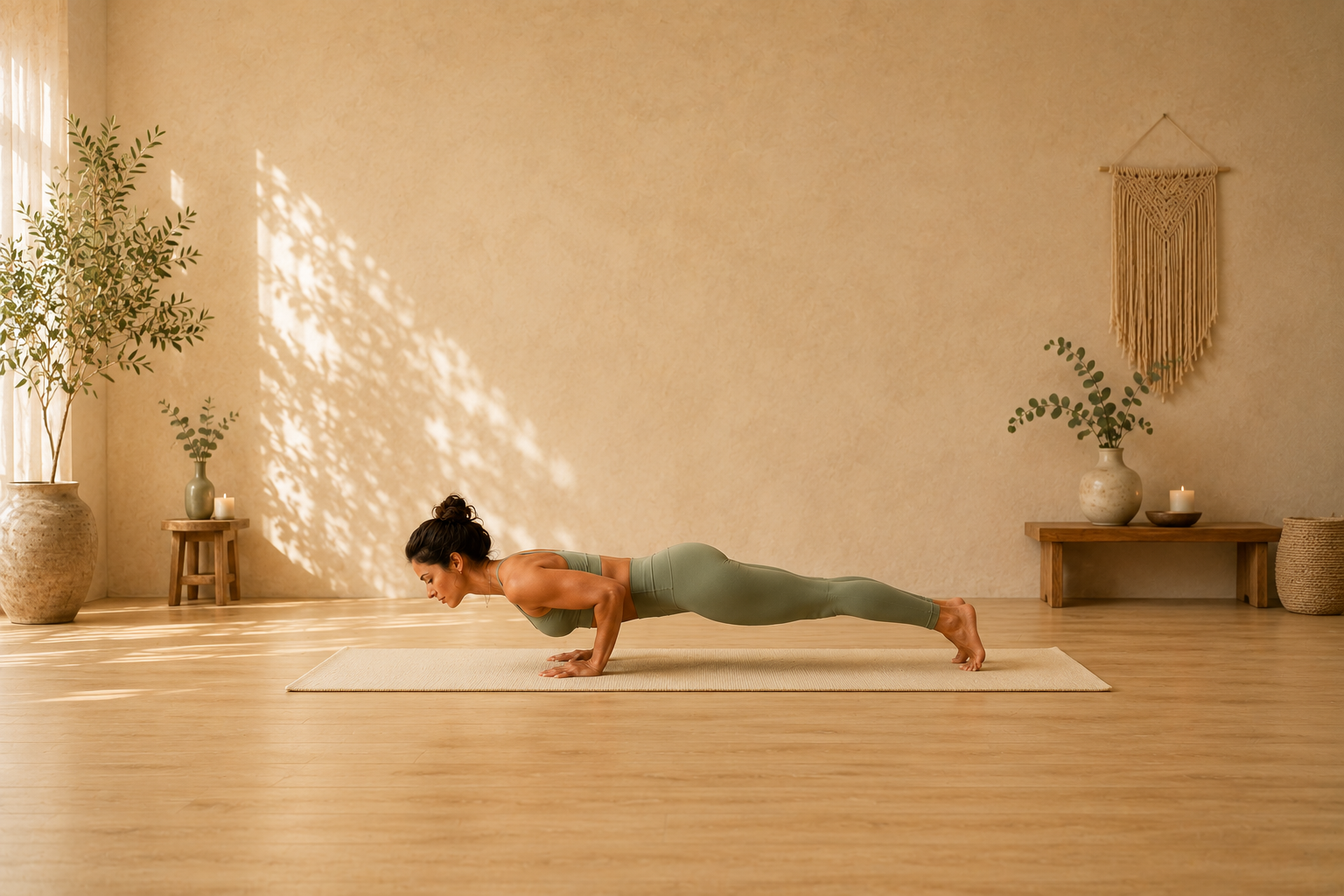
Four-Limbed Staff Pose (Chaturanga Dandasana), often simply called Chaturanga, is one of the most frequently practiced poses in dynamic yoga classes. Present in most sun salutations, it involves holding the body parallel to the floor, supported on the hands and toes.
Its Sanskrit name literally means "four-limbed staff pose":
- Chatur: four
- Anga: limbs
- Danda: staff
Far more than a simple transition, Chaturanga forms the base of many arm balances: Crane Pose (Bakasana), Crow Pose (Kakasana), Side Crow Pose (Parsva Bakasana) and Peacock Pose (Mayurasana). Mastering this pose builds the strength, control and stability that all these advanced asanas require.
Stable shoulders, strong arms, engaged core: what Chaturanga asks for is exactly what arm balances require. This article walks through how to do the pose well, how to build toward it progressively, and why it plays such a foundational role in practice.
I. The Pose: How to Do It Well
Four-Limbed Staff Pose (Chaturanga Dandasana) is a suspended elbow flexion. The body forms a straight line parallel to the floor, elbows bent at 90 degrees, arms close to the torso.
1. The Hands: Distributing the Weight
Palms are flat, fingers slightly spread. Pressure distributes across the whole hand, from the base of the fingers to the heel of the palm. Rather than letting the wrists bear everything, let the fingers press actively into the floor.
2. The Body Line: Heel to Neck
The body holds one continuous line without a break. The hips stay level with the body, neither too high nor sagging. The lower abdomen draws very slightly upward, which supports the lumbar spine without arching it. The gaze rests a few centimetres ahead of the hands, the neck in line with the spine.
3. The Shoulders: The Key Point
The shoulders lower to the level of the elbows, not below. The shoulder blades stay close to the back, away from the ears. The elbows track along the ribs throughout the descent, staying in line with the wrists.
This shoulder placement is what distinguishes a pose that protects the joints from one that gradually strains them.
4. The Muscles at Work
Triceps and pectorals support the descent. The transversus and deep abdominals maintain the line of the torso. Glutes and quadriceps keep the legs active. The serratus anterior muscles stabilize the shoulder blades against the ribcage.
II. Building Toward Chaturanga: A Progressive Path
Chaturanga calls for a combination of core strength, arm strength and shoulder stability. These qualities build gradually, through more accessible poses, before moving to the full form.
1. Start with Plank
Plank Pose (Phalakasana) is the foundation. Hold for 30 to 60 seconds while keeping a perfect line: heels pressing back, shoulder blades active, transversus engaged. This is where the body learns to maintain the line that Chaturanga will then ask for in motion.
2. The Knees-Down Variation: A Step in Its Own Right
Knees on the floor, toes tucked or flat. The body lowers the same way as in the full version: shoulders level with the elbows, a straight line from knees to neck. This variation lets you work on shoulder alignment and elbow control without the full body weight.
This is a valid option at any level, not just for beginners. Five well-placed knee-down lowerings build more effectively than ten rushed full ones.
3. Forearm Plank
Forearm Plank (Makara Adho Mukha Svanasana) develops deep core engagement and shoulder stability in a position that spares the wrists. Elbows at 90 degrees, forearms parallel. Hold for 30 to 60 seconds, keeping the hips in line with the torso.
4. Slow Lowering
The most direct way to build Chaturanga: from Plank Pose (Phalakasana), lower very slowly over 5 to 8 seconds, keeping the line, elbows close. Rest on the floor if needed, then press back up.
Three to five repetitions per session is enough. The controlled lowering phase (eccentric) is as valuable as the push-up.
5. Cobra for Back Strength
Cobra Pose (Bhujangasana) strengthens the muscles that stabilize the shoulder blades in Chaturanga: the rhomboids and spinal extensors. Lying on the floor, palms under the shoulders, lift the chest using the back muscles rather than hand pressure. The effort should come from the back, not the arms.
IV. Chaturanga and Sun Salutations
In a classic sun salutation, the passage through Chaturanga repeats with each cycle. This repetition is what makes it a particularly effective strengthening tool, provided the form is correct.
1. Repetition as a Strengthening Programme
Five to ten sun salutations, three to four times a week: that is a significant workload for the shoulders, arms and core. The triceps, pectorals, anterior deltoids and shoulder stabilizers work with every descent. The wrists progressively adapt to the load in extension.
This strengthening is gradual and cumulative. You may not notice it day to day, but over several weeks, the difference shows up in overall upper-body stability.
2. Using Variations Intelligently
In a sun salutation, it makes complete sense to alternate between full Chaturanga and the knees-down variation depending on fatigue or where you are in the session. The knees-down variation is not a compromise: it is a quality choice.
Five Chaturangas on the knees with impeccable alignment are worth more than ten full Chaturangas with sagging shoulders.
3. The Transition to Cobra or Downward Dog
The transition from Chaturanga to Cobra Pose (Bhujangasana) or to Downward-Facing Dog (Adho Mukha Svanasana) is as instructive as the pose itself.
Toward Cobra: the shoulders stay active, you don't collapse to the floor. The chest opens forward, the elbows keep a slight bend.
Toward Downward Dog: turning the toes and pressing the hands, the pelvis lifts back and up. The shoulders stay away from the ears.
In both cases, the connection between core and shoulders established in Chaturanga carries through into the next pose.
V. The Foundation of Arm Balances
Chaturanga prepares for arm balances in a concrete, not abstract, way. The qualities it builds are precisely the ones those poses require.
1. Core Engagement: What Allows You to Lift Off
In Crow Pose (Kakasana) or Crane Pose (Bakasana), the two most accessible entry-level arm balances, the body must compact and lift. This depends entirely on the ability to engage the deep core and draw the hips upward. It is exactly the same recruitment as in the controlled descent of Chaturanga.
Practicing Chaturanga with care builds that core engagement without needing to look for it directly in arm balances.
2. Shoulder Stability: What Prevents Collapse
In Chaturanga, the shoulder blades stay close to the back and the elbows track along the ribs. That same placement, in Eight-Angle Pose (Astavakrasana) or Firefly Pose (Tittibhasana), stops the shoulders from caving under the body's weight. Without that stability, the arms bear the load but the shoulders give way.
3. A Concrete Progressive Path
The step from Chaturanga to the first arm balances happens naturally when the foundations are solid:
- Plank Pose (Phalakasana): hold the line, activate the core
- Knees-down Chaturanga variation: shoulder control without full load
- Four-Limbed Staff Pose (Chaturanga Dandasana) with slow lowering
- Crow Pose (Kakasana): first accessible arm balance, bent arms close to the torso
- Crane Pose (Bakasana): straighter arms, greater core demand
- Eight-Angle Pose (Astavakrasana): hip rotation, core and shoulder stability combined
This is not a fixed rule but a reflection of what Chaturanga builds step by step. If an advanced pose feels stuck, returning to the controlled descent is often more useful than continuing to attempt the pose itself.
VI. Conclusion
Chaturanga Dandasana is one of those poses you pass through hundreds of times before you truly practice it. Its quiet presence in sequences masks what it actually asks for: precise alignment, active shoulder stability and constant core engagement.
Taken seriously, it strengthens the shoulders, arms and core in a gradual and consistent way. It prepares the body for arm balances without having to seek them out directly. And in sun salutations, every carefully executed repetition is an opportunity to build something solid.
As is often the case in yoga, the quality of the movement matters more than the speed at which you pass through it.