
 Prenatal & Postpartum Yoga
Stretching During Pregnancy: The Benefits of Stretching and the Precautions Linked to Relaxin
Stretching During Pregnancy: The Benefits of Stretching and the Precautions Linked to Relaxin
You might notice that some movements feel easier during pregnancy, almost loose, while other familiar poses suddenly feel off. That shift isn't in your head. Your body starts preparing for birth long before your due date, and that preparation changes how your joints and tissues respond to movement.
The question comes up often in prenatal yoga classes: can you keep stretching while pregnant, and if so, how? This article looks at what's actually happening in your body, what the science does and doesn't yet know about relaxin, and how to adapt your stretching practice so it stays comfortable from the first trimester to the third.
I. What's Happening in Your Body: The Role of Relaxin
During pregnancy, your body produces more relaxin, a hormone released by the corpus luteum and later by the placenta. Its name comes straight from what it does: it helps loosen certain connective tissues to prepare the pelvis for birth.
Here's what's well established, backed by several independent studies: ligament laxity and joint mobility increase progressively over the course of pregnancy, a change measured notably at the knees and ankles (Schauberger et al., 1996; Marnach et al., 2003). In practice, that means your joints can move through a greater range than before, without you having changed anything about your practice.
Relaxin's role in these changes is accepted in broad terms: it's one of the hormones involved in loosening connective tissue. But the exact mechanism, especially its link to certain pains or feelings of instability some women experience, is still debated in the scientific literature. Several studies found no direct correlation between blood relaxin levels and the degree of joint laxity measured (Schauberger et al., 1996; Vøllestad et al., 2012). In other words, relaxin is part of the picture, but it doesn't explain everything, and your blood level of it won't predict what you'll actually feel.
II. A Different Kind of Mobility, Not Just More of It
Across the trimesters, joint range isn't the only thing that changes. Your center of gravity shifts forward as your belly grows, your posture adjusts, and your pelvis tilts to compensate. Deep muscle tone, especially around the pelvis, reorganizes too.
The result: two women at the same stage of pregnancy can feel very different things when it comes to mobility, depending on their body, their activity level before pregnancy, and how their body compensates for these changes. That's why there's no universal benchmark for "normal" flexibility during pregnancy. The only reliable guide is how you feel right now.
III. The Benefits of Gentle Stretching During Pregnancy
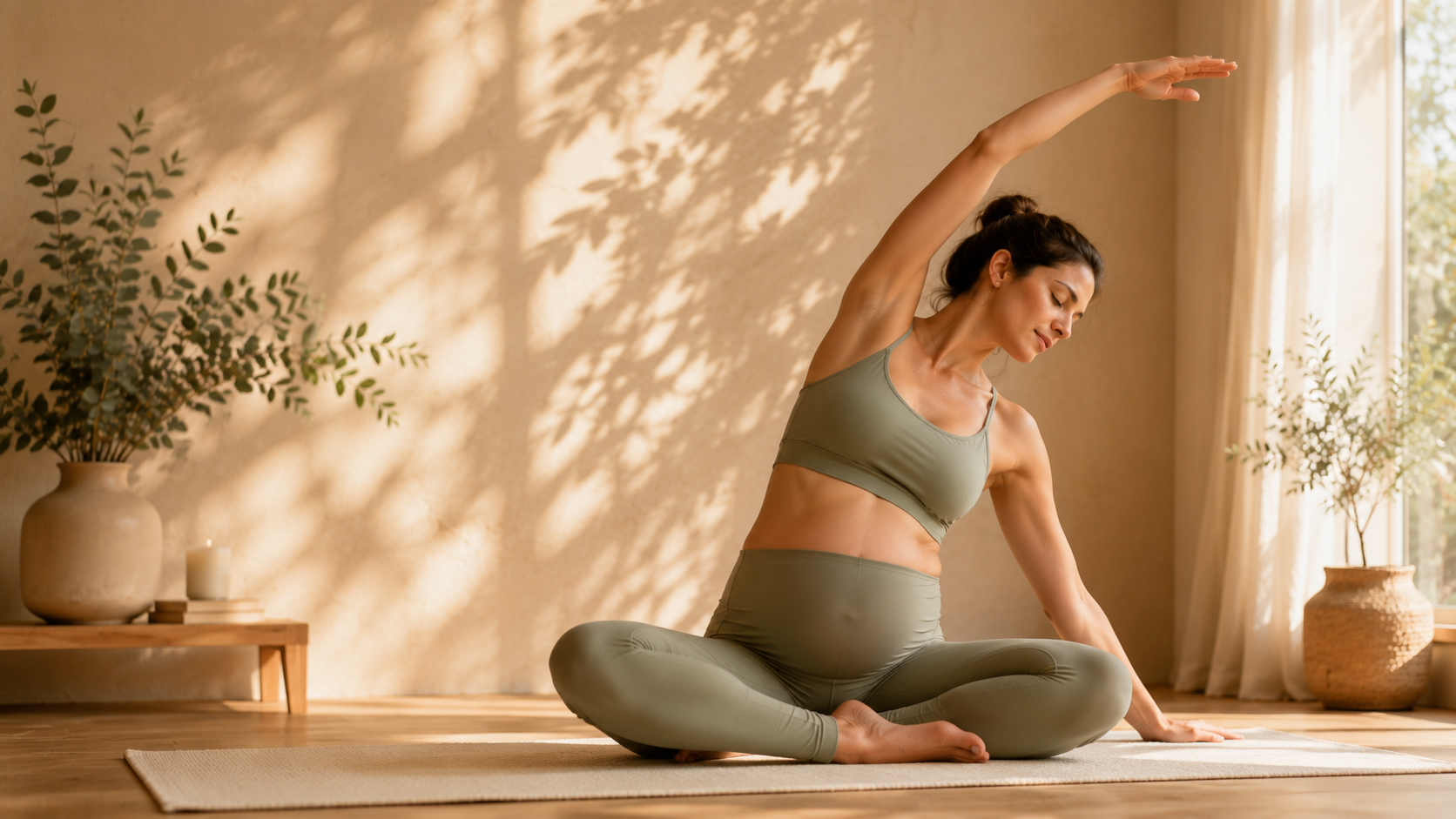
Gentle stretching during pregnancy, kept within a comfortable range, can offer real benefits. Tension that builds up in the lower back and hips from your shifting posture eases a little. Circulation in the legs, often sluggish later in pregnancy, benefits from movement. Sleep, disrupted by physical discomfort, can improve too.
A review of the prenatal yoga literature (Curtis, Weinrib & Katz, 2012) linked a regular, adapted practice to reduced perceived stress and lower back and pelvic pain in some pregnant women. These effects don't come from gaining flexibility itself, but from repeated movement, slower breathing, and paying attention to what your body is telling you.
IV. The Risk of Overstretching
This is where the nuance matters. Because your connective tissues are already looser during pregnancy, pushing a joint toward its maximum range takes less effort than before, but it also carries a bigger risk: asking a joint to go further than it can stabilize on its own. Without the same ligament resistance you had before pregnancy, your body relies more heavily on muscles to keep joints in place. A stretch pushed too far, or held too long at the end of its range, can create a feeling of instability, or even pain, in a joint that no longer has its usual reference points.
That's why the goal of stretching during pregnancy is never to gain more range. Your body already has, temporarily, more mobility than usual. The priority becomes stabilizing that mobility, not adding to it.
V. Moving with Care: Precautions to Keep in Mind
A few simple guidelines let you keep moving without putting unnecessary strain on your joints.
- Stay within a comfortable range, never at the point of maximal stretch. Pain threshold is no longer a reliable guide during pregnancy.
- Favor active, moderate stretches held for a few breaths, rather than static positions held for a long time at the end of range.
- Pair stretching with strengthening, especially around the pelvis and hips, so your muscles have the means to stabilize what your ligaments stabilize less.
- Avoid sudden movements or bouncing, which put sudden strain on joints that are already more mobile than usual.
- From the second trimester on, limit time spent lying on your back, and favor lying on your side or semi-reclined, with a cushion under one knee.
- Listen to what your body offers each day. Mobility can vary from one session to the next, sometimes from one day to the next, depending on fatigue, heat, or how far along you are.
VI. Pelvic and Pubic Symphysis Pain: When to Be More Careful
Some women feel, especially in the second or third trimester, localized pain at the front of the pelvis, around the pubic symphysis, or diffuse pain across the pelvic girdle. It's tempting to assume that relaxin, by loosening the pelvic ligaments, directly causes this pain. That link is far from proven.
A systematic review focused specifically on this question (Aldabe et al., 2012) found insufficient evidence to say that relaxin levels cause pregnancy-related pelvic pain. A correlation may exist for some women, but the exact mechanism isn't understood, and other factors, biomechanical, postural, or muscular, likely play a role too. In other words, relaxin loosens tissue, that much is established, but it isn't identified as the sole cause, or even the main cause, of pelvic pain during pregnancy.
What matters in practice: if you feel pain building, especially around the pubic bone, going up stairs or shifting your weight from one leg to the other, that's not a reason to push a stretch further to "release" the area. It's actually a signal to reduce your range of motion, avoid very asymmetrical, wide-legged poses, and check in with a health professional, a midwife, physical therapist, or osteopath trained in prenatal care, who can assess the situation and suggest an approach suited to you.
VII. Prenatal Yoga, a Practice Built for This Moment
Prenatal yoga starts from exactly this idea: during pregnancy, practice isn't about pushing your body's limits, it's about supporting it through its changes.
Moving through Table Pose (Bharmanasana), gently flowing into Cat-Cow Pose (Marjaryasana-Bitilasana), mobilizes the spine without putting weight on the belly and eases tension in the lower back.
Goddess Pose (Utkata Konasana) opens the hips in an active, standing position with bent knees. It strengthens the thighs while it stretches, a useful balance during pregnancy since it stabilizes as much as it loosens.
Butterfly Pose (Baddha Konasana), seated with the soles of the feet together, remains one of the most used poses in prenatal yoga for gently opening the hips without putting excess tension on the pelvis.
Child Pose (Balasana), knees wide to make room for your belly, offers a moment of rest between movements, any time during a session.
A prenatal yoga class, guided by a teacher trained for this specific stage, lets you adapt each pose to how far along you are, your body, and how you feel that day. It's also a chance to practice slower breathing, often useful well beyond the mat.
VIII. Conclusion
Stretching during pregnancy is still possible, and for many women, enjoyable and useful. What changes is the goal. Your body naturally gains mobility through several hormonal mechanisms, relaxin among them, without being the whole story. This new mobility isn't an invitation to go further, it's ground to stabilize, one breath at a time.
As is often true in yoga, the most useful practice isn't the one that pushes a limit, but the one that learns to listen to it.
Scientific References
- Schauberger CW, Rooney BL, Goldsmith L, Shenton D, Silva PD, Schaper A. "Peripheral joint laxity increases in pregnancy but does not correlate with serum relaxin levels." American Journal of Obstetrics and Gynecology, 1996.
- Marnach ML, Ramin KD, Ramsey PS, Song SW, Stensland JJ, An KN. "Characterization of the relationship between joint laxity and maternal hormones in pregnancy." Obstetrics & Gynecology, 2003.
- Vøllestad NK, Torjesen PA, Robinson HS. "Association between the serum levels of relaxin and responses to the active straight leg raise test in pregnancy." Manual Therapy, 2012.
- Aldabe D, Ribeiro DC, Milosavljevic S, Bussey MD. "Pregnancy-related pelvic girdle pain and its relationship with relaxin levels during pregnancy: a systematic review." European Spine Journal, 2012.
- Curtis K, Weinrib A, Katz J. "Systematic Review of Yoga for Pregnant Women: Current Status and Future Directions." Evidence-Based Complementary and Alternative Medicine, 2012.