
 Prenatal & Postpartum Yoga
Heavy Legs During Pregnancy: Yoga Poses That May Help
Heavy Legs During Pregnancy: Yoga Poses That May Help
At the end of the day, your shoes feel tighter. Your ankles are swollen. Sometimes, all you want to do is put your feet up for a few minutes and enjoy a little relief.
During pregnancy, the sensation of heavy legs is very common. It affects more than one in two pregnant women, especially from the second trimester onward and during warmer months.
Although it is usually harmless, it can become uncomfortable in everyday life.
The good news is that certain movements, breathing techniques, and yoga poses may help support circulation and relieve that feeling of heaviness.
Let's look at why it happens and which poses may help you feel a little lighter.
I. Why Do Legs Feel Heavy During Pregnancy?
Several factors contribute to heavy legs during pregnancy.
Hormonal changes cause the walls of the veins to relax. As a result, veins become more flexible and blood has a harder time returning efficiently to the heart.
At the same time, the growing uterus takes up more space in the abdomen. This pressure can slow venous return from the legs.
Heat can also make symptoms worse. Blood vessels dilate more easily, and feelings of heaviness often become more noticeable during summer.
Mild swelling in the feet and ankles at the end of the day is common.
However, if swelling appears suddenly, affects only one leg, or is accompanied by significant pain, it is important to seek medical advice promptly.
II. How Can Yoga Support Circulation?
Yoga supports circulation through several complementary mechanisms.
Standing poses engage the muscles of the legs, especially the calves. These muscles are sometimes referred to as the body's "second heart" because their contractions help push blood back toward the upper body.
Breathing also plays an important role. With each inhale and exhale, the diaphragm creates a natural pumping action that supports both venous return and lymphatic circulation.
Finally, some poses simply use gravity to their advantage. When the legs are elevated, fluids can circulate more easily and the feeling of heaviness often decreases quickly.
This is what makes yoga different from simple stretching. Movement, breath, and body position work together to support circulation.
III. Yoga Poses That May Help
Warrior II Pose (Virabhadrasana II)
This standing pose activates the legs while building stability.
Holding the posture for several breaths gently engages the calves and thighs, which may help support venous return.
Stay for 5 to 8 breaths on each side.
Garland Pose (Malasana)
This pose opens the pelvis, mobilizes the ankles, and encourages circulation throughout the lower body.
It can feel especially pleasant when your legs feel heavy after spending long periods sitting or standing.
Breathe slowly here for one to two minutes.
Wide-Angle Seated Forward Bend (Upavistha Konasana)
This pose creates space through the pelvis and inner legs.
Practiced with support under the knees or torso, it encourages relaxation while helping slow the breath.
Stay for one to three minutes.
Reclined Bound Angle Pose (Supta Baddha Konasana)
Supported by a bolster or several cushions, this pose allows the pelvis and abdomen to soften completely.
Breathing becomes fuller and the nervous system gradually settles.
Stay for 5 to 10 minutes if it remains comfortable.
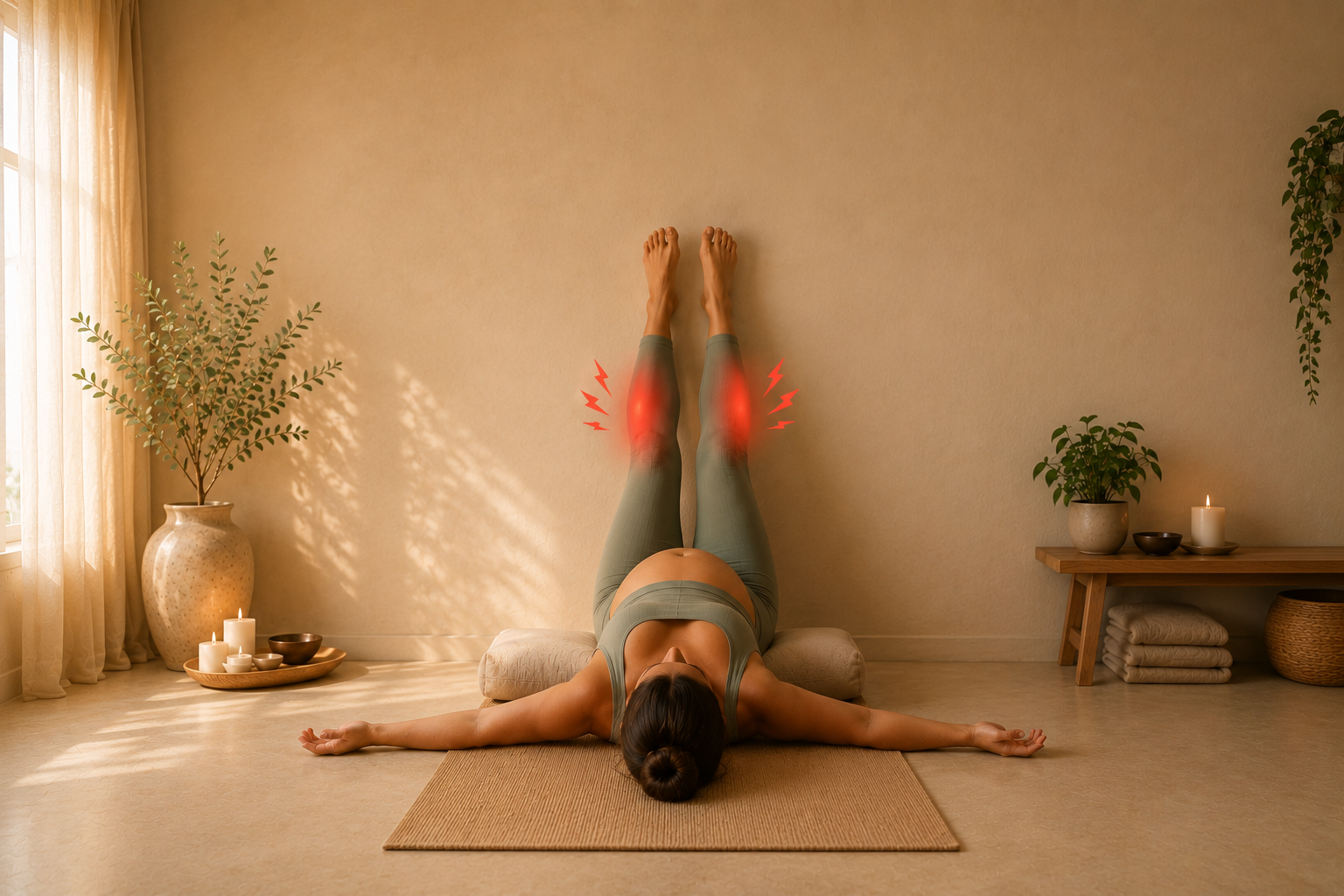
Legs Up the Wall Pose (Viparita Karani)
This is probably the best-known pose for relieving heavy legs.
By elevating the legs, gravity naturally assists venous return.
Many pregnant women notice a feeling of lightness after just a few minutes.
You can move slightly away from the wall or place cushions under the pelvis to find a comfortable variation during pregnancy.
Stay for 5 to 10 minutes while breathing naturally.
IV. A 15-Minute Routine for Lighter Legs
This sequence combines movement, breath, and restorative poses to support circulation through several different mechanisms.
- Warrior II Pose (Virabhadrasana II) — 1 minute on each side.
- Garland Pose (Malasana) — 1 to 2 minutes.
- Wide-Angle Seated Forward Bend (Upavistha Konasana) — 2 to 3 minutes.
- Reclined Bound Angle Pose (Supta Baddha Konasana) — 5 minutes.
- Legs Up the Wall Pose (Viparita Karani) — 5 to 10 minutes.
Practicing this sequence at the end of the day may help bring more comfort when your legs feel heavy or swollen.
V. Everyday Habits That Complement Yoga
Yoga can be a valuable tool, but it is not the only one.
You may also benefit from:
- elevating your legs for a few minutes in the evening;
- walking regularly throughout the day;
- staying well hydrated;
- avoiding long periods of standing without moving;
- finishing your shower with cooler water on the legs.
Some women also benefit from compression stockings prescribed by their healthcare provider.
VI. Frequently Asked Questions
Are heavy legs during pregnancy normal?
Yes. This sensation is common, especially from the second trimester onward, when blood volume increases and venous return becomes less efficient.
During which trimester do heavy legs usually appear?
They often begin during the second trimester and may become more noticeable during the third trimester.
Is Viparita Karani safe during pregnancy?
Yes, as long as the pose remains comfortable. Feel free to use cushions or move slightly away from the wall to adapt it to your needs.
How long should I stay in Legs Up the Wall Pose?
Five to ten minutes is usually enough to notice a feeling of greater lightness.
VII. Conclusion
Heavy legs are one of the most common discomforts during pregnancy.
Although they do not always disappear completely, a few minutes of movement, breathing, and supportive yoga poses may help you feel more comfortable throughout the day.
As is often the case in yoga, the goal is not to fight the body, but to support it through the changes it is experiencing.