
 Asanas & Anatomy
Crow Pose VS Crane Pose
Crow (Kakasana) vs Crane (Bakasana): What is the Difference?
Two birds, two poses, one very common confusion. Crow Pose and Crane Pose are among the most practiced arm balances in yoga — and among the most often mixed up.
While they share the same goal — learning to balance the body on the hands while building strength, focus and confidence — their execution, difficulty level and the muscles involved are not quite the same.
So what is the real difference between Crow Pose (Kakasana) and Crane Pose (Bakasana)?
I. Why Are They So Often Confused?
The confusion starts with the names. Today the term Crane Pose (Bakasana) is often used indiscriminately for both variations.
Yet the tradition is clear:
- Crow Pose (Kakasana): crow pose.
- Crane Pose (Bakasana): crane pose.
These two poses nonetheless share many similarities. They share common technical principles and benefits.
1. Common Technical Keys
- The gaze plays an essential role in balance.
Fix a point on the floor about 30 to 50 centimetres in front of your hands. Keep the back of the neck long and relaxed. Looking directly at your hands often prevents the weight from shifting forward, while looking too high can create unnecessary tension.
- Core engagement is key. Contrary to popular belief, these poses do not rely solely on arm strength. The true engine is the centre of the body. To lift the feet off the floor:
- engage the deep abdominals;
- gently draw the ribs inward;
- actively press the floor with the hands;
- keep the legs active.
The more the core is engaged, the lighter and more stable the pose becomes.
2. Benefits of Crow and Crane
Both poses develop:
- arm and shoulder strength;
- deep core engagement;
- balance;
- coordination;
- concentration;
- body awareness;
- self-confidence.
They are also excellent preparation for other arm balances such as Side Crow Pose (Parsva Bakasana), Firefly Pose (Tittibhasana) or Eight-Angle Pose (Astavakrasana).
II. What Sets Them Apart?
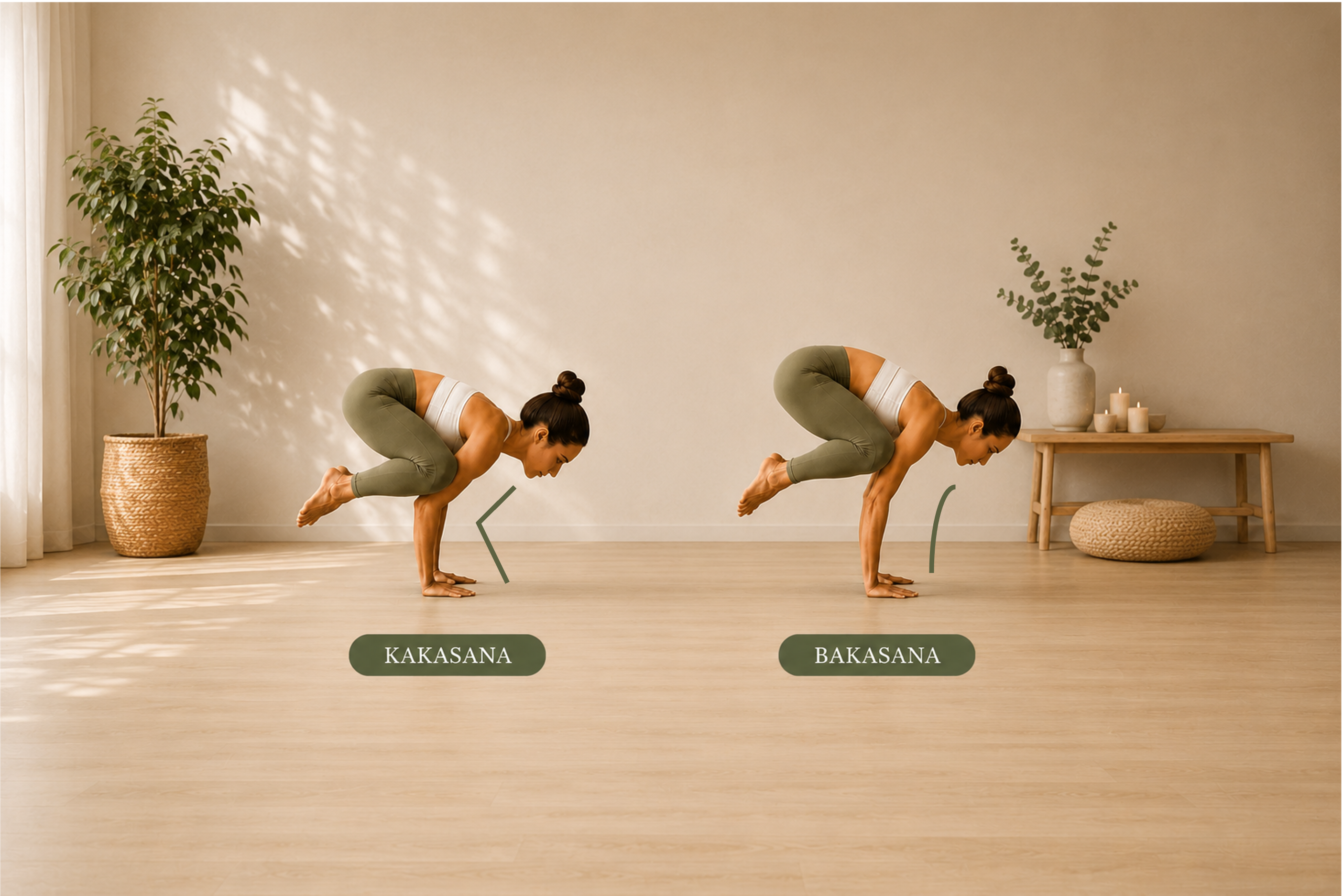
Beyond the name, the difference is mainly anatomical: the arm position completely changes the pose.
Crow Pose (Kakasana)
In Crow Pose (Kakasana), the arms remain bent and the knees rest on the triceps, near the elbows. The centre of gravity stays relatively low, making the balance more stable and accessible.
This position creates a natural support for the legs. The knees anchor on the arms, allowing the practitioner to find balance more easily.
It is generally the first arm balance taught in yoga.
Why Is It More Accessible?
When the elbows stay bent:
- the centre of gravity is lower;
- the knees find an easy point of support;
- the fear of tipping forward decreases;
- balance is easier to control.
Crow Pose teaches the fundamentals of weight transfer, core engagement and the confidence needed for hand balances.
Crane Pose (Bakasana)
In Crane Pose (Bakasana), the arms are straight or nearly straight. The knees or shins ride higher on the arms, near the armpits. The pelvis lifts higher and the body weight rests almost entirely on the hands.
The pose becomes lighter, more aerial and more demanding.
Why Is It More Difficult?
Straightening the arms significantly increases the demands of the pose:
- greater shoulder strength;
- more wrist stability;
- more intense core engagement;
- better control of the centre of gravity.
The slightest release of the core can lead to loss of balance.
Crow vs Crane: Key Differences
| Crow (Kakasana) | Crane (Bakasana) |
|---|---|
| Arms bent | Arms straight |
| Knees on triceps | Knees or shins high on arms (near armpits) |
| Low centre of gravity | High centre of gravity |
| More stable | More demanding |
| Accessible to beginners | Intermediate to advanced level |
| Moderate strength | Significant strength |
| Feeling of grounding | Feeling of lightness |
Crane can be seen as the natural evolution of Crow. Once the foundations are built, gradually straightening the arms allows for exploring a more advanced version of the balance.
III. Most Common Mistakes
- Looking down, looking at your hands: this error often prevents the weight from shifting forward and makes lifting off difficult.
- Jumping into the pose: balance builds progressively. Trying to jump in generally leads to a loss of control.
- Letting the elbows splay out: the arms lose stability and the knees are likely to slip.
- Collapsing in the shoulders: actively press the floor to keep the shoulder blades engaged and the upper back slightly rounded.
- Holding the breath: flowing breath helps maintain calm and stability in the pose.
IV. How to Progress from Crow to Crane?
Progression is built step by step:
- Stabilise Crow Pose (Kakasana) for several breaths.
- Strengthen the wrists, shoulders and core.
- Work on weight transfers forward.
- Gradually lift the pelvis higher.
- Begin to slightly straighten the arms.
- Explore Crane Pose (Bakasana) without forcing the pose.
For many practitioners, Crane appears naturally once sufficient strength, technique and confidence have developed.
V. Conclusion
Crow and Crane share the same spirit: learning to trust the body while cultivating strength, stability and lightness.
Crow is generally the first step. More stable and accessible, it builds the foundations needed for arm balances. Crane then pushes the exploration further, asking for more strength, precision and engagement.
One prepares the other. Crow grounds, Crane elevates.
And as is often the case in yoga, what matters is not so much reaching the pose as learning everything it has to teach us along the way.